
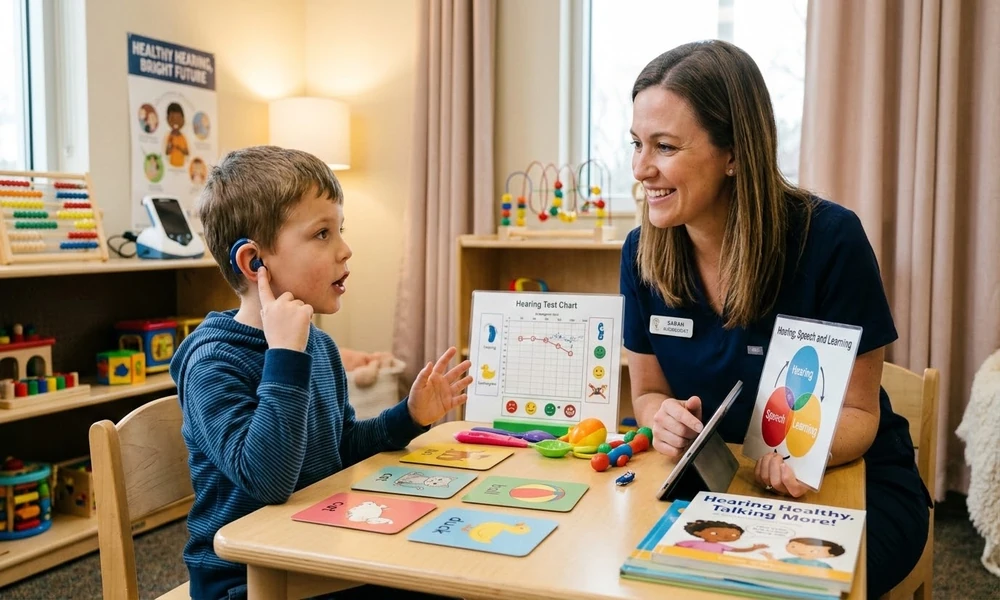
Communication development in children is shaped by many things, including language exposure, social interaction, neurological development, attention, and hearing health. When a child has trouble speaking clearly, following directions, responding to their name, or joining classroom activities, it can be hard to tell where the challenge begins. Some children may have a speech or language delay. Others may be dealing with hearing difficulties. Sometimes, both are involved.
Hearing plays a major role in how children learn spoken language. Even mild or temporary hearing issues can affect communication, learning, and social development. A child does not need to be completely unable to hear for these areas to be affected. Difficulty hearing certain sounds, hearing inconsistently, or struggling to understand speech in noisy places can all shape the way a child communicates.
Understanding this connection can help families, educators, and healthcare providers spot concerns earlier and support children more effectively.
Why Hearing Matters for Communication Development
Children learn language by listening. From infancy, they take in speech sounds, tone, rhythm, and meaning through repeated exposure. Over time, those listening experiences help children connect sounds to words, words to ideas, and ideas to social interaction. When hearing is reduced or inconsistent, a child may miss important pieces of that learning process.
Hearing challenges can affect both receptive and expressive communication. Receptive communication refers to what a child understands, such as following directions or recognizing familiar words. Expressive communication refers to how a child uses words, gestures, sounds, or sentences to communicate. When a child cannot clearly hear speech sounds, they may have trouble understanding language and later producing it accurately.
These effects can be easy to miss. A child may hear some sounds but not others. They may hear well in quiet settings but struggle in classrooms, playgrounds, or group conversations. Adults may think the child is ignoring directions, distracted, shy, or delayed for another reason. In reality, the child may be working much harder than others to process spoken information.
Common Signs of Hearing or Communication Concerns
Hearing and communication challenges often show up during everyday routines. A child may frequently ask people to repeat themselves, turn up the volume on devices, respond inconsistently when called, or seem confused during conversations. Younger children may not startle at loud sounds, may not babble as expected, or may use fewer words than other children their age.
In school-age children, hearing difficulties may look like academic or behavioral concerns. A child might miss instructions, fall behind in reading, avoid group work, or seem inattentive during lessons. Since classrooms are often noisy, children with hearing challenges may struggle there even if they seem to hear normally at home.
Families may also notice speech patterns that suggest a child is not hearing sounds clearly. For example, a child may leave off word endings, mispronounce certain consonants, or speak unusually loudly or softly. These signs do not automatically mean a child has hearing loss, but they may point to the need for further evaluation.
The Role of Hearing Evaluations in Early Identification
A hearing evaluation can help determine whether a child can detect and understand sounds across different frequencies and listening conditions. This information can clarify whether communication concerns may be related to hearing health, speech-language development, or another developmental factor.
Early evaluation is especially important because young children may not be able to explain what they are hearing or missing.
Pediatric hearing testing is designed to match a child’s age and developmental level. For infants and toddlers, testing may involve observing responses to sound or using technology that measures how the ear and auditory system respond. Older children may take part in listening tasks, speech recognition activities, or tests that assess how well the middle ear is working.
Advanced Audiology Care provides pediatric hearing testing, which reflects the type of specialized evaluation that may be appropriate when families or providers have concerns about a child’s listening and communication development. Pediatric hearing assessments can help guide next steps, such as monitoring, medical follow-up, classroom support, or additional developmental services.
Temporary Hearing Issues Can Still Affect Learning
Not all hearing concerns are permanent. Children may have temporary hearing changes due to ear infections, fluid in the middle ear, allergies, congestion, or earwax buildup. These issues are common, especially in early childhood, but they can still affect communication when they happen often or last for a long time.
Temporary hearing reduction can be especially important during key language-learning years. When a child repeatedly misses speech sounds during the period when vocabulary, grammar, and sound awareness are developing, they may need extra support even after the hearing issue improves. This is why families and providers often track both hearing history and communication milestones.
In classroom settings, temporary hearing problems can make it harder for children to follow lessons, especially when teachers speak from a distance or there is background noise. A child may seem to understand one day and feel lost the next. That inconsistency can be frustrating for children and confusing for adults unless hearing health is considered as part of the bigger picture.
Developmental Support Beyond Hearing Testing
When a child has communication delays, a hearing evaluation is only one part of the process. Some children may also benefit from speech-language therapy, developmental screening, behavioral support, occupational therapy, or educational interventions. The right approach depends on the child’s needs, strengths, age, and environment.
Children with developmental differences may communicate in many ways. Some use spoken language. Others rely on gestures, signs, pictures, assistive communication tools, or behavior. In these situations, professionals often look at how the child communicates needs, responds to social cues, manages transitions, and participates in learning activities.
Sunshine Advantage offers ABA therapy services in New Mexico, a type of developmental support that may be used for children who need help building communication, social, behavioral, or adaptive skills. ABA therapy is not a hearing service, but it can be part of a broader support plan when communication challenges are connected to developmental or behavioral needs.
How Hearing Health and Behavior Can Overlap
Hearing difficulties can sometimes look like behavior problems. A child who does not respond to instructions may be seen as defiant. A child who withdraws from group play may be viewed as shy. A child who becomes frustrated during conversations may be labeled disruptive. In some situations, the underlying issue may be that the child is not hearing or processing speech clearly.
That does not mean every behavioral concern is caused by hearing problems. Still, hearing should be considered when a child shows sudden changes in behavior, ongoing difficulty following directions, or frustration during communication. Ruling out hearing-related factors can prevent misunderstandings and help adults respond with more patience and accuracy.
Children may also develop coping habits when they cannot hear well. They may watch others for cues, copy classmates, avoid answering questions, or rely heavily on visual information. These strategies can help them get by, but they may also hide the problem. A child who seems capable in familiar routines may still struggle when listening demands increase.
The Importance of Coordinated Pediatric Care
Children often benefit most when care is coordinated. A pediatrician, audiologist, speech-language pathologist, teacher, and developmental specialist may each notice different parts of the child’s communication profile. When these observations are shared, families can get a clearer understanding of what the child needs.
Primary care providers are often the first point of contact when families have concerns. They may screen hearing, check for ear infections, monitor milestones, and refer families for further evaluation. Pediatric care can also help identify whether communication concerns may be connected to broader health or developmental factors.
Kimball Health Services provides pediatric healthcare services and family care, which aligns with the type of general healthcare setting where families may begin asking questions about hearing, speech, learning, or development. Starting with a trusted healthcare provider can help families decide whether a hearing test, developmental screening, or school-based evaluation is needed.
Support Strategies at Home and in School
Evaluations are important, but daily support matters too. At home, caregivers can help by speaking face-to-face, reducing background noise during conversations, reading aloud, naming objects during routines, and giving children enough time to respond. These strategies support language development whether or not a child has a confirmed hearing difficulty.
In school, children may benefit from preferential seating, visual instructions, repetition of key information, captioned media, smaller group instruction, or assistive listening technology. Teachers can also check for understanding instead of assuming a child heard and processed the instruction the first time. Small changes in the learning environment can reduce listening effort and improve participation.
For children who use hearing aids or other hearing technology, consistency is important. Devices need to fit properly, function well, and be used regularly when recommended. Apex Audiology works in audiology, hearing aids, and hearing care, areas that may be part of ongoing support for children or families managing hearing-related needs. Hearing technology is most effective when paired with follow-up care, family education, and communication support.
When Families Should Seek Further Guidance
Families may want to seek guidance when a child has delayed speech, unclear speech, inconsistent responses to sound, frequent ear infections, difficulty following directions, or school struggles that are hard to explain. Concerns from teachers or caregivers should also be taken seriously, especially when the same patterns appear in more than one setting.
It can help to write down observations before an appointment. Families might note when the child responds well, when they seem to struggle, whether the issue changes in noisy places, and whether there is a history of ear infections or hearing concerns. These details can help providers decide what type of evaluation is most appropriate.
Parents and caregivers do not need to identify the cause on their own. Communication development is complex, and many children need more than one type of support. The goal is not to assign a label quickly. The goal is to understand the child’s needs and create a plan that supports learning, connection, and confidence.
Conclusion
Hearing health and communication development are closely connected. When children struggle to speak, listen, follow directions, or participate in learning, hearing should be considered as one possible piece of the puzzle. Even mild or temporary hearing issues can affect how children understand language, interact with others, and engage in school.
Hearing evaluations, developmental support, and coordinated pediatric care can help families move from uncertainty to practical next steps. With early identification and the right support, children have a better chance to build communication skills, participate more fully in learning, and feel more understood in everyday life.