
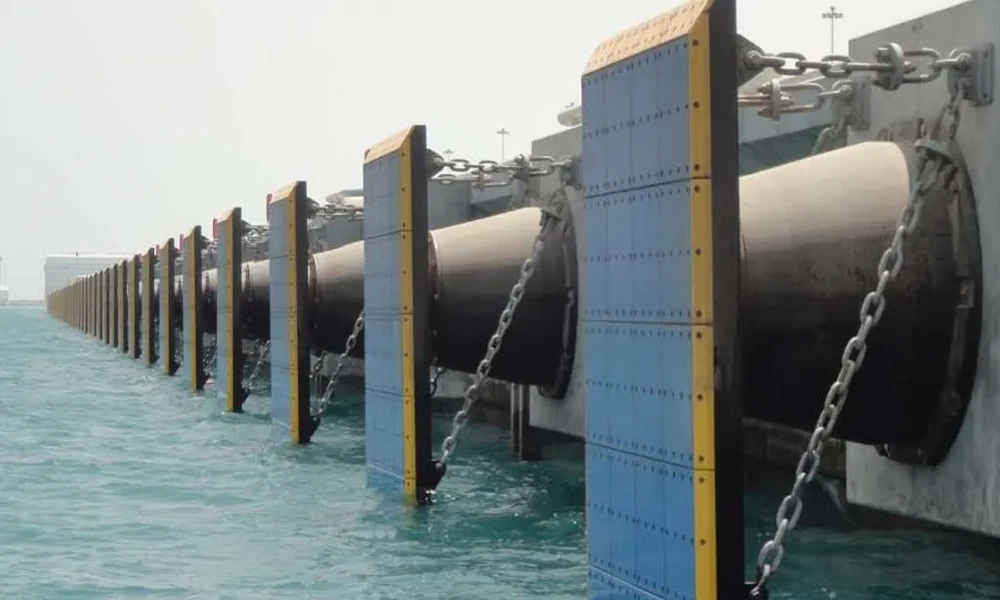
Marine rubber fenders serve the most physically demanding application in port and maritime infrastructure: absorbing the kinetic energy of a vessel at berthing without damaging the hull, the wharf structure, or the fender itself. The energy involved in a loaded vessel making contact with a berth at even a slow approach speed is considerable, and the fender system’s ability to absorb and distribute that energy safely determines the safety of the berthing operation and the longevity of both the vessel and the port structure. Selecting the correct rubber fender type and specification requires understanding both the fender geometry’s performance characteristics and the specific energy absorption requirement of the vessels and port environment involved.
Why Fender Selection Matters
An undersized or incorrectly specified rubber fender that cannot absorb the design berthing energy will bottom out, transferring the excess energy directly to the wharf structure as an unattenuated impact load. Over-stiff fenders that require more compression force than the hull can safely accept without local deformation create a different problem: hull damage rather than wharf damage. Correct fender selection balances these two requirements against the specific vessel type, approach velocity, and berth geometry that characterize the installation.
Principal Types of Marine Rubber Fenders
Rubber fenders for marine applications are manufactured in several geometric configurations whose performance profiles differ:
- Cylindrical fenders: the simplest and most widely used fender type for general cargo berths, tug and workboat applications, and offshore supply vessel operations. Their circular cross-section provides consistent energy absorption regardless of contact angle.
- D-type fenders: D-shaped cross-section fenders used extensively for ship-to-ship transfer operations, small craft fendering on dolphins and pontoons, and as supplementary fendering on general purpose berths
- Cell fenders: square-sectioned hollow fenders that combine high energy absorption with moderate reaction force, suitable for medium to large vessel berthing applications at commercial ports
- Arch fenders: curved profile fenders providing very high energy absorption relative to face area, popular at berths serving large bulk carriers and tankers where hull contact area is limited
- Cone fenders: provide the highest energy absorption in the smallest footprint, used at berths with limited available panel area and for very high-energy berthing applications
- Foam-filled fenders: buoyant, resilient fenders for ship-to-ship and jettyless mooring applications where a floating fender is required
Material Quality in Rubber Fender Manufacturing
The quality of the rubber compound used in marine rubber fender manufacturing determines the fender’s performance consistency across its service life, its resistance to the ozone, UV, and salt water degradation of the marine environment, and the accuracy with which its rated energy absorption and reaction force values are maintained in practice.
Quality rubber fenders are manufactured using natural rubber or SBR compounds formulated to PIANC guidelines, with carbon black loading, antiozonants, and antidegradants at levels that maintain the compound’s elastic properties across the service temperature range and resist the environmental degradation that unprotected rubber undergoes in outdoor marine exposure.
Installation and Maintenance Considerations
Rubber fender installation quality directly affects performance and service life. Fenders mounted on incorrectly positioned anchor bolts, at wrong angles to the vessel contact face, or with face pads that are not correctly aligned create uneven loading that accelerates fatigue failure. Regular inspection for surface cracking, ozone attack, and loss of elasticity allows replacement before fender performance degrades to unsafe levels.
Conclusion
Correct marine fender selection, specification, and installation are important engineering considerations for ports and offshore facilities. Choosing the appropriate fender type, rubber compound, dimensions, and manufacturing quality helps provide the energy absorption needed during berthing operations. A properly specified marine fender can help reduce impact forces and protect vessels, port structures, and personnel while supporting reliable performance across repeated berthing operations throughout its expected service life.